Extensive Pneumoperitoneum in a Hemodynamically Stable 62-Year-Old Male Managed Conservatively: A Case Report Emphasizing the Importance of Clinical Judgment Over Radiological Findings
Idiopathic Pneumoperitoneum
Abstract
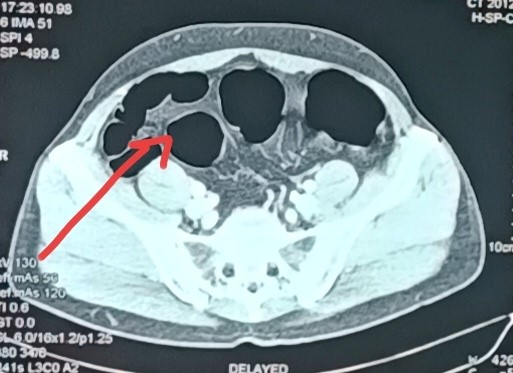
Pneumoperitoneum is most commonly caused by gastrointestinal perforation and classically mandates emergency surgical exploration. A distinct subgroup of spontaneous (non-surgical) pneumoperitoneum exists in which free intraperitoneal air is not accompanied by clinical peritonitis, and the source of air cannot be identified even after thorough investigation. We report a 62-year-old male who presented with diffuse abdominal pain, vomiting, and obstipation. Contrast-enhanced computed tomography (CT) of the abdomen revealed extensive pneumoperitoneum with free air under the right hemidiaphragm, multiple extraluminal air foci in the peritoneal cavity, and marked colonic distension. Despite these findings, the patient showed no signs of peritonitis and remained hemodynamically stable. After an exhaustive workup including contrast-enhanced CT, erect abdominal radiography, and sigmoidoscopy failed to identify an ongoing perforation source, a diagnosis of spontaneous pneumoperitoneum — most plausibly representing a self-sealed microscopic gastrointestinal perforation — was established as a diagnosis of exclusion. The patient was managed conservatively with nasogastric decompression, intravenous fluids, intravenous piperacillin–tazobactam for four days followed by a five-day course of oral cefuroxime after discharge, and bowel rest, with complete clinical resolution over a four-day hospitalization. Follow-up colonoscopy and upper gastrointestinal endoscopy performed fifteen days after discharge were entirely normal. This case illustrates that extensive pneumoperitoneum in a carefully selected, hemodynamically stable patient without peritonitis may be managed non-operatively when CT and endoscopy reveal no evidence of ongoing leak or contamination and close observation confirms clinical improvement. Conservative management in this setting must remain highly selective, with a low threshold for urgent laparotomy should deterioration occur.
Downloads
References
[2] Mularski RA, Sippel JM, Osborne ML. Pneumoperitoneum: a review of nonsurgical causes. Crit Care Med . 2000;28(7):2638-2644.
[3] Daoud R, Ali NF, Salman ES, Almansoor M, Daoud SM. Navigating asymptomatic idiopathic pneumoperitoneum: a case report and a literature review. Cureus . 2024;16(3):e55687.
[4] Hannan E, Saad E, Hoashi S, Toomey D. The clinical dilemma of the persistent idiopathic pneumoperitoneum: a case report. Int J Surg Case Rep . 2019;63:10-12.
[5] Agha RA, Borrelli MR, Farwana R, Koshy K, Fowler AJ, Orgill DP, et al. The SCARE 2018 statement: updating consensus Surgical CAse REport guidelines. Int J Surg . 2018;60:132-136.
[6] Hainaux B, Agneessens E, Bertinotti R, Rubesova E, Capelluto E, Moschopoulos C, et al. Accuracy of MDCT in predicting site of gastrointestinal tract perforation. AJR Am J Roentgenol . 2006;187(5):1179-1183.
[7] Tani T, Mori T, Shimono R, Takiguchi S, Kono S, Kusunoki M, et al. Conservative management of idiopathic pneumoperitoneum masquerading as peritonitis: report of a case. Surg Today . 1995;25:265-267.
[8] Tanaka R, Kameyama H, Nagahashi M, Ichikawa H, Hanyu T, Ishikawa T, et al. Conservative treatment of idiopathic spontaneous pneumoperitoneum in a bedridden patient: a case report. Surg Case Rep . 2015;1:73.
[9] Peker K, Gulkan S, Ercan M, Cengiz F, Dikici MF, Diker M, et al. Spontaneous pneumoperitoneum: is it really a surgical indication? Ulus Travma Acil Cerrahi Derg . 2017;23:516-520.
[10] Chandler JG, Berk RN, Golden GT. Misleading pneumoperitoneum. Surg Gynecol Obstet . 1977;144:163-174.
[11] Morrison M, Brown S, Enders R, Kondolojy M, Sardi A. Conservative management for spontaneous pneumoperitoneum. Edorium J Surg . 2018;5:100028S05MM2018CS.
[12] Sidiqi MM, Fletcher D, Billah T. The enigma of asymptomatic idiopathic pneumoperitoneum: a dangerous trap for general surgeons. Int J Surg Case Rep . 2020;76:33-36.
[13] Udelsman B, Qadan M, Chang DC, Yeh DD. Management of pneumoperitoneum. Ann Surg . 2021;274(1):146-154.

This work is licensed under a Creative Commons Attribution 4.0 International License.